The gap
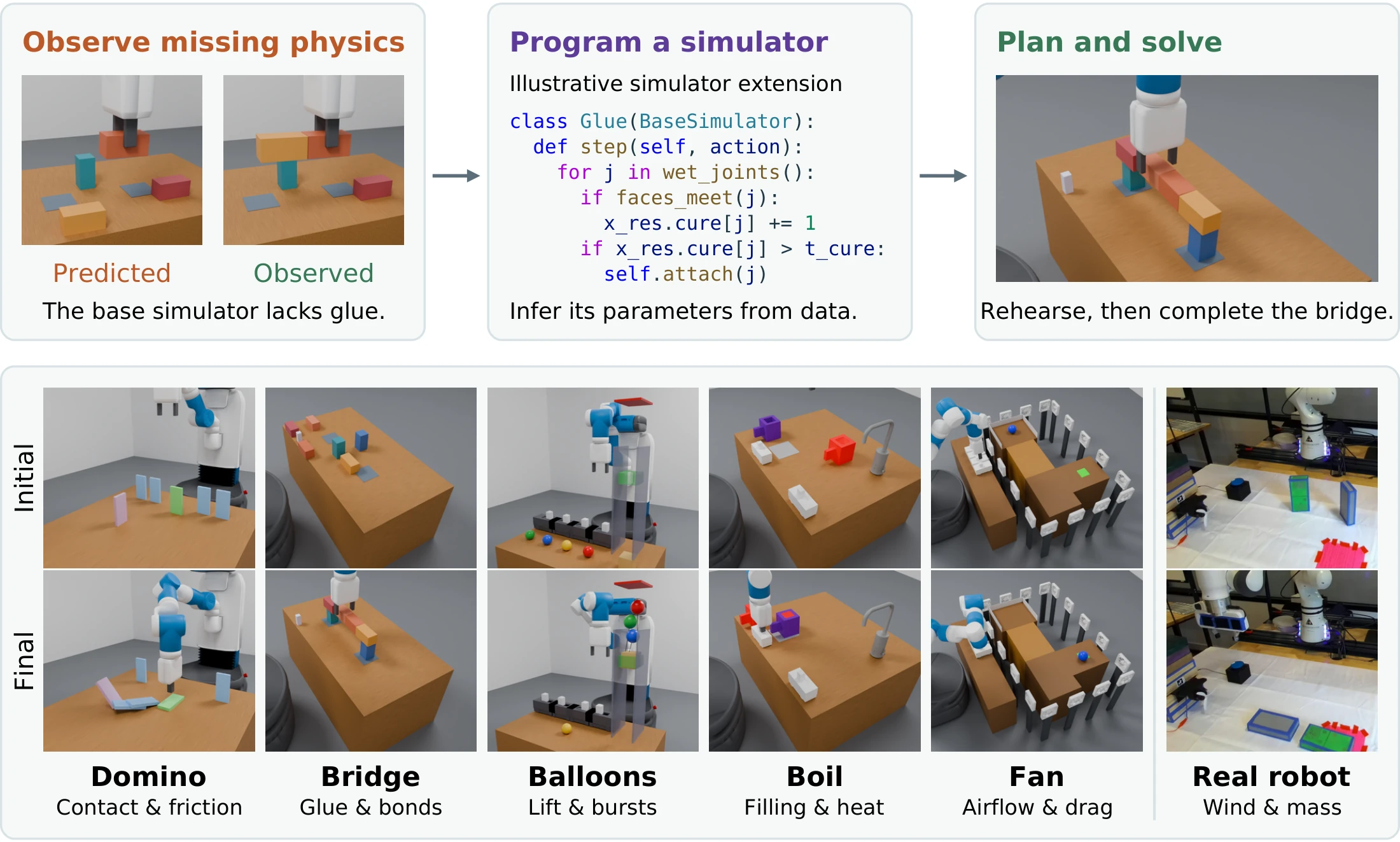
Physics engines supply knowledge of motion and contact, but can omit entire mechanisms, such as glue curing, water heating, or wind.
*,†Equal contribution
EMPIRIC extends a physics engine with code for the physics it is missing, infers that code's parameters from a few noisy experiments, and plans with the result.
01 Overview
A robot should be able to learn through experiments how unfamiliar objects behave and interact, then plan with that knowledge.
Physics engines supply knowledge of motion and contact, but can omit entire mechanisms, such as glue curing, water heating, or wind.
EMPIRIC learns a residual world model: a physics engine extended with code for the missing mechanisms. The programs can add forces, constraints, and hidden state, and Bayesian inference estimates their parameters and states from noisy observations. The model lets the agent predict the outcomes of actions, choose informative experiments, and revise its hypotheses when predictions fail.
Across five simulated domains, EMPIRIC learns interpretable, reusable models, and solves more tasks with fewer environment interactions than all three baselines. On a physical robot, it learns wind forces and domino masses to solve a manipulation task.
02 Method
A coding agent starts from a base simulator of generic rigid-body physics and extends it with code for novel physical mechanisms. The engine provides reusable knowledge of motion and contact, so learning can focus on the physics it lacks.
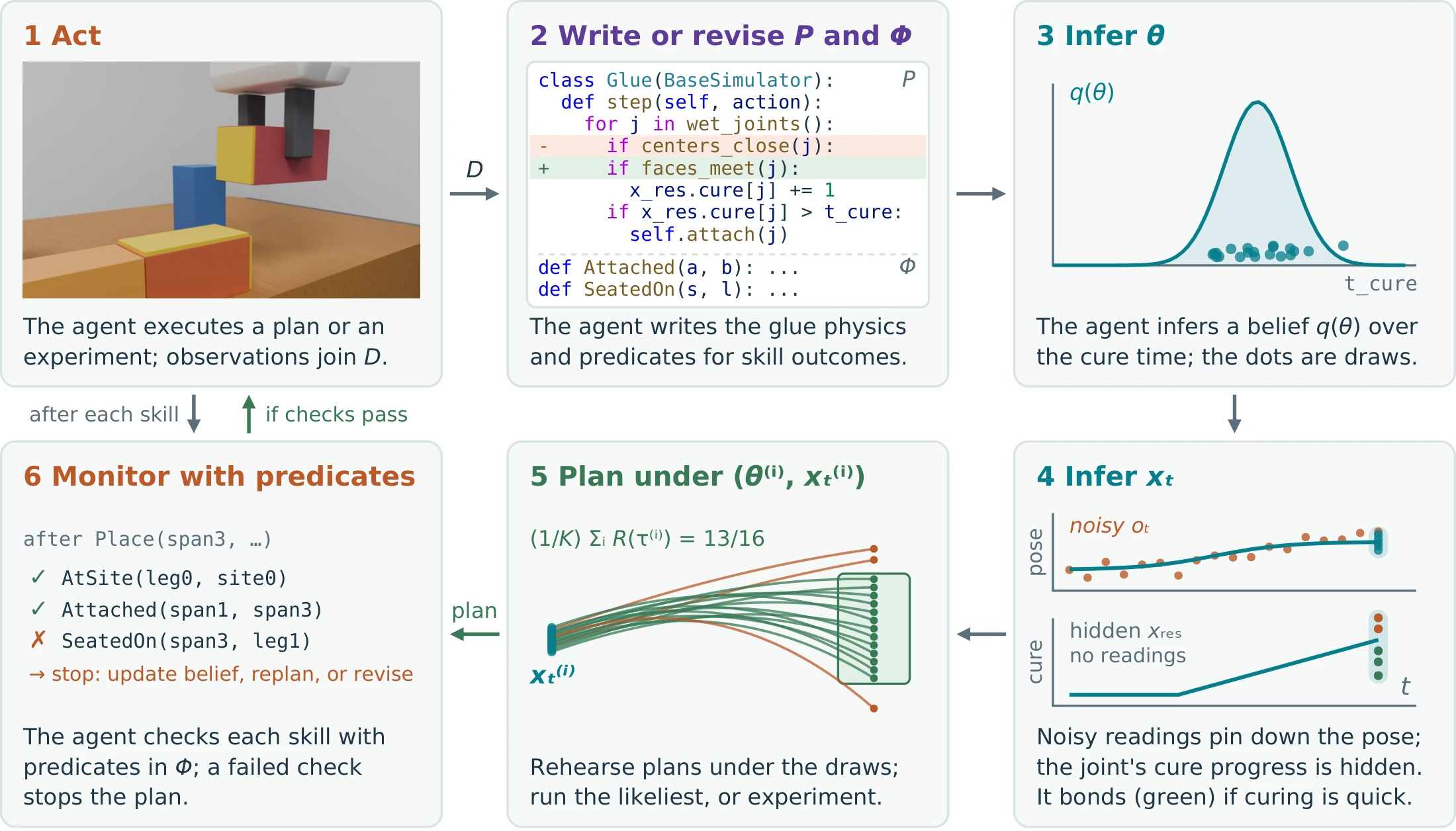
The agent writes a program that subclasses the physics engine and adds what it lacks: forces, constraints, and quantities such as water volume, temperature, or a glued joint's cure progress.
From noisy observations, the agent infers a belief over the program's parameters and the current state, including the hidden quantities the program tracks.
The agent simulates candidate plans under draws from this belief and executes the plan most likely to succeed. When an uncertain quantity decides the outcome, it runs an experiment first, and when execution contradicts the model, it revises the program.
03 Results
We compare EMPIRIC with three baselines, an oracle with the ground-truth dynamics, and two ablations, over five seeds in each domain. All agents use Claude Opus 5 and share the same skills, noisy observations, and step budgets. A run succeeds only if every training and test task is solved.
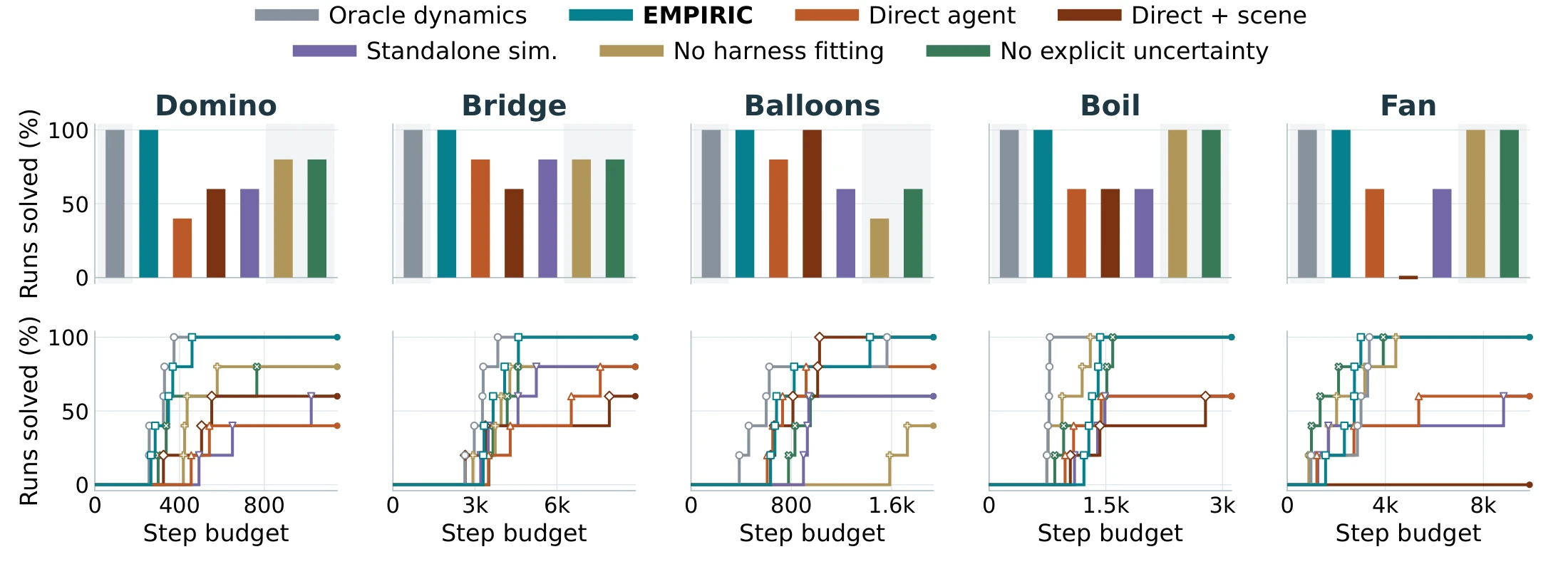
In every domain, EMPIRIC reaches a 60% solve rate with fewer steps than any baseline that reaches it at all. The comparisons suggest that part of the advantage comes from simulating robot skills together with the underlying physics: baselines often fail when they extrapolate beyond what they observed, such as extending a straight cascade to a turning one.
EMPIRIC matches Oracle dynamics at 25/25 runs. It uses 12–18% more steps than Oracle in Domino, Bridge, and Balloons, 74% more in Boil, and 8% fewer in Fan: correct dynamics alone do not guarantee efficiency, because Oracle must still estimate the state from noisy observations.
Without harness fitting, 20/25 runs succeed, and without explicit uncertainty, 21/25. In Balloons, where releases cannot be undone, EMPIRIC solves 5/5 runs, against 2/5 and 3/5 for the two ablations.
04 Real robot
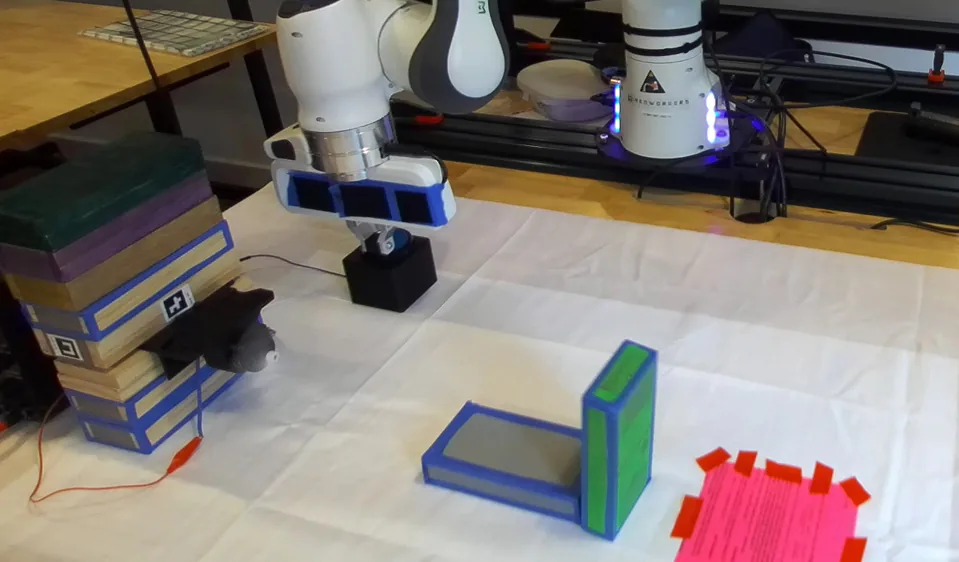
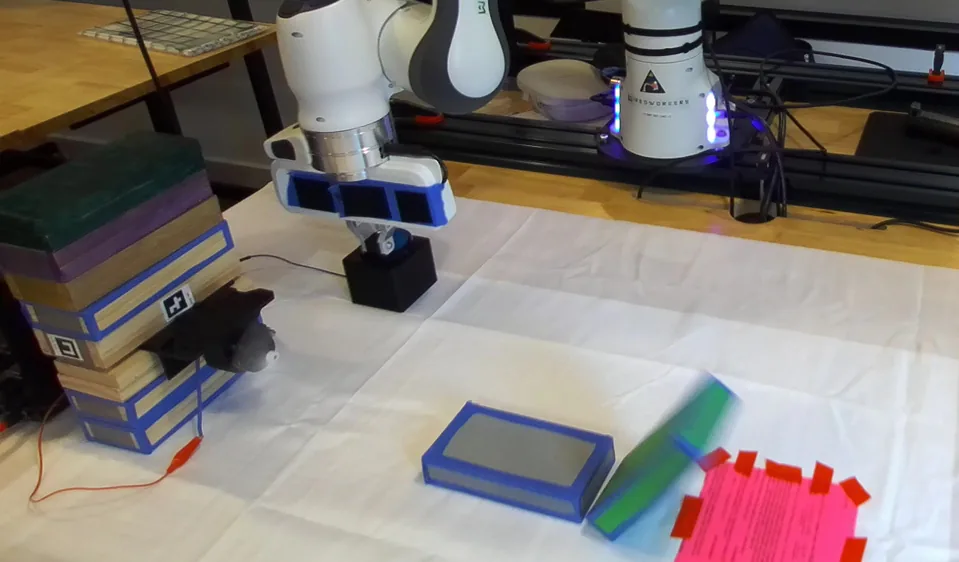
In a physical Fan–Domino task, the robot knows neither the fan's wind nor the masses of its two dominoes. The training goal is to land the lighter domino flat in a target patch with one gust. At test, the patch moves farther downwind, and the robot must reach it with the heavier domino.
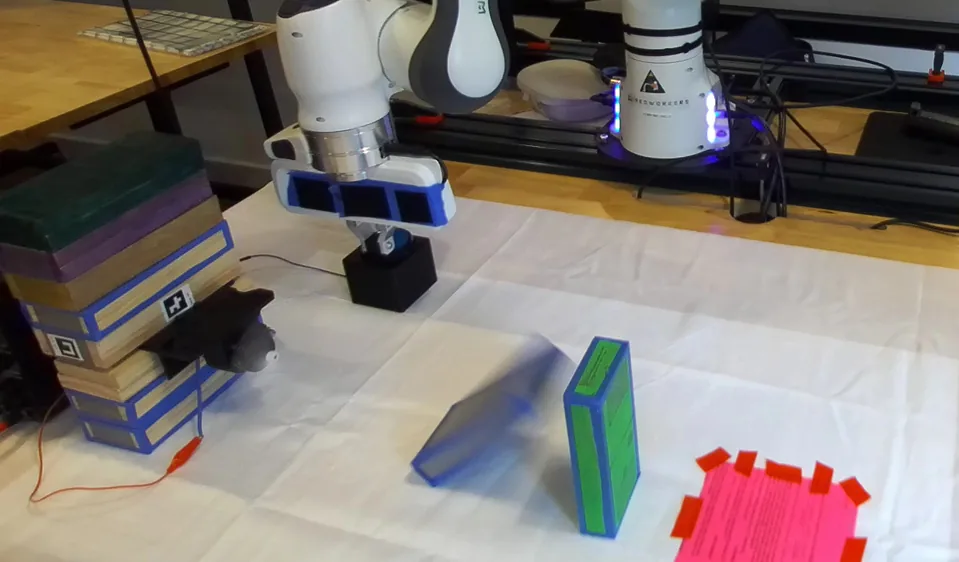
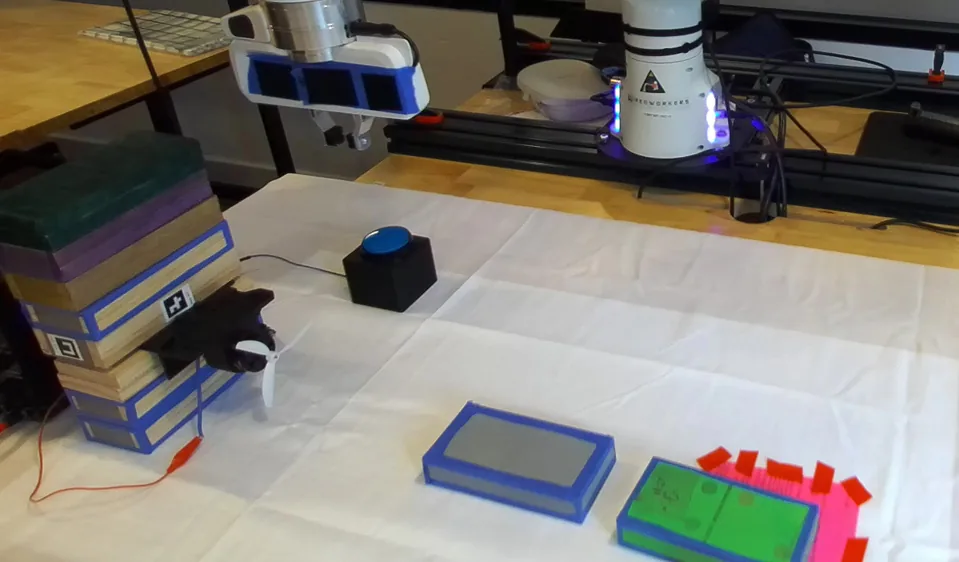
From two gusts, EMPIRIC learns a wind force that decays after the fan stops and infers both masses. Its model predicts that no placement of the green domino alone reaches the new patch, so the agent stands the gray domino upwind, where its fall knocks the green one in.
The green block before and after a gust, then the gray block before and after. The green block stays upright; the gray block falls into the target.
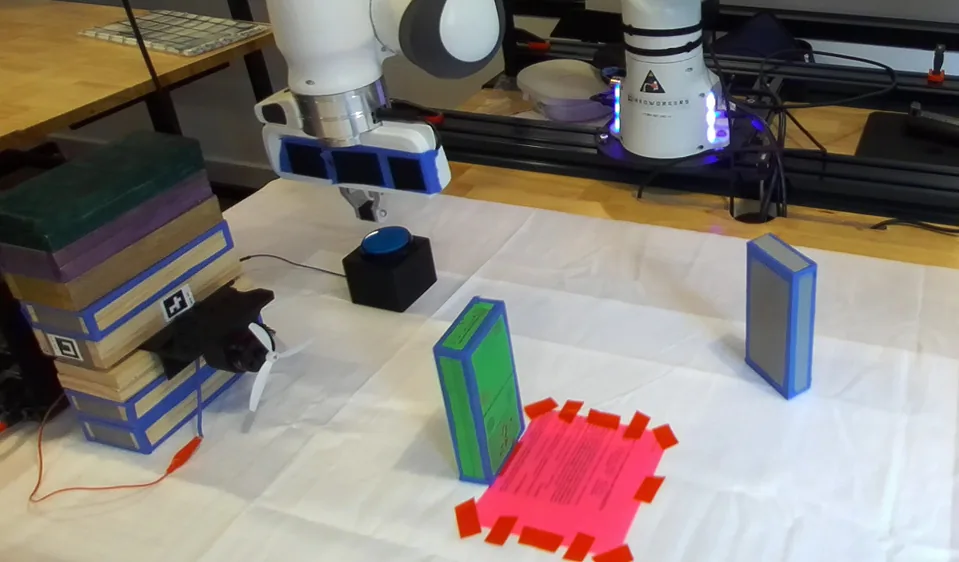
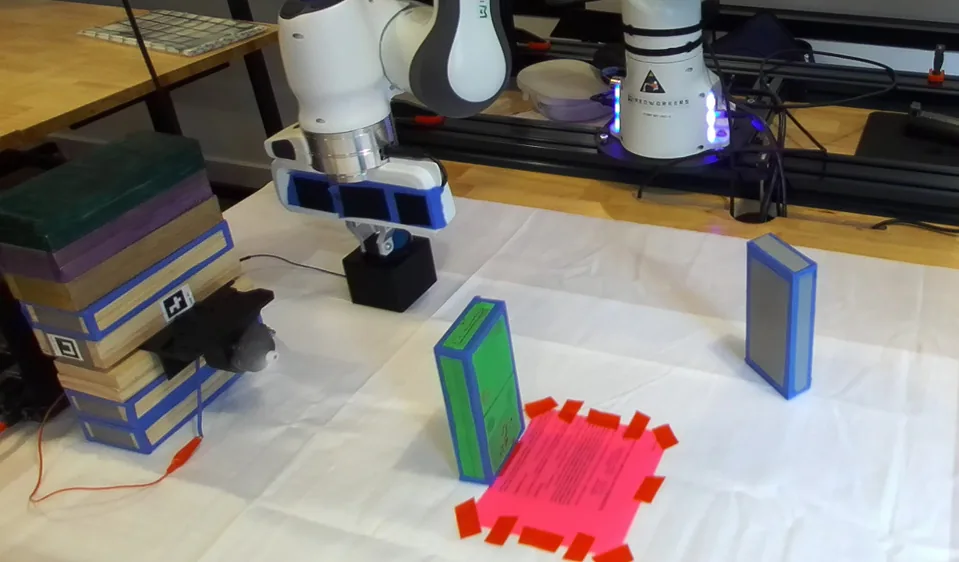
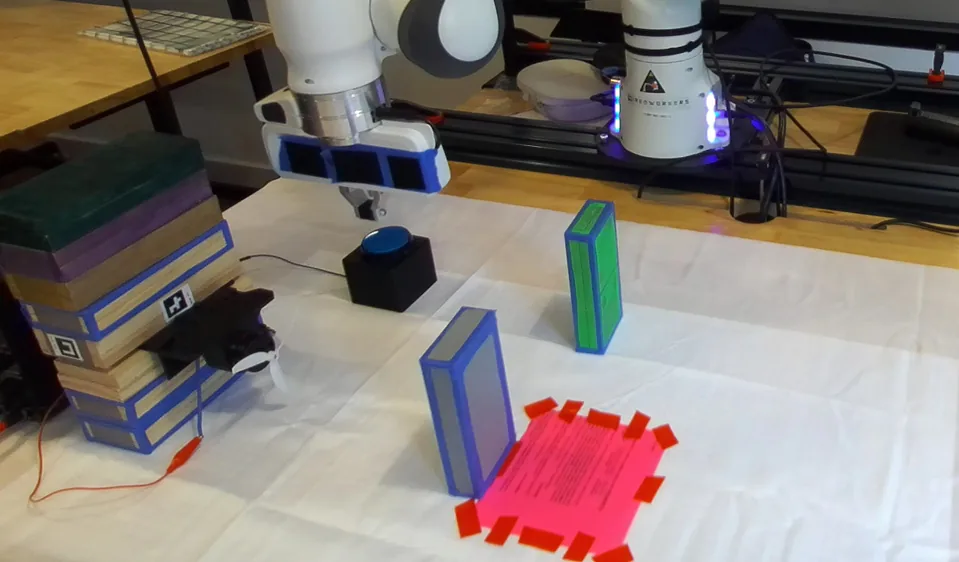
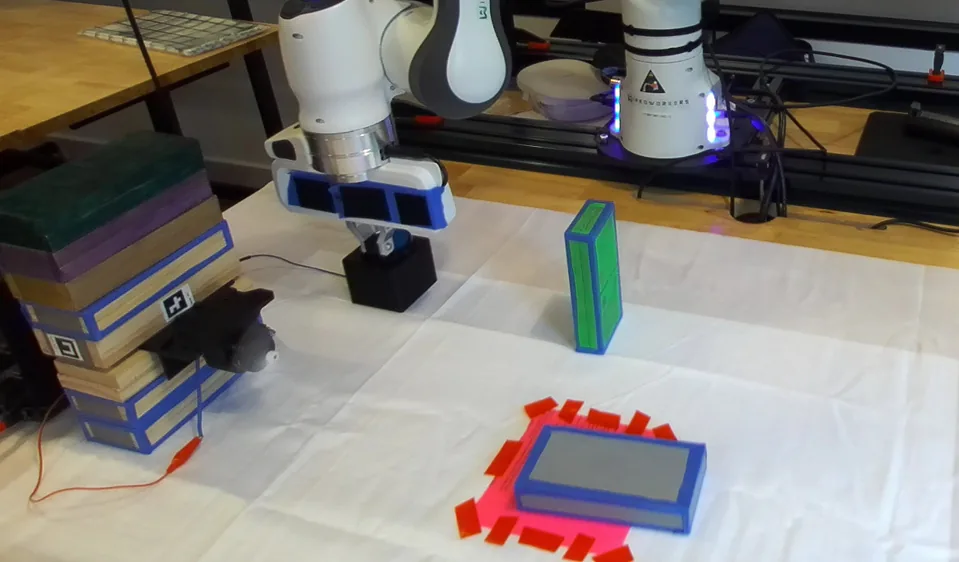
The relocated target, the green block placed first, the gray block placed upwind of it, and the robot pressing the fan button.
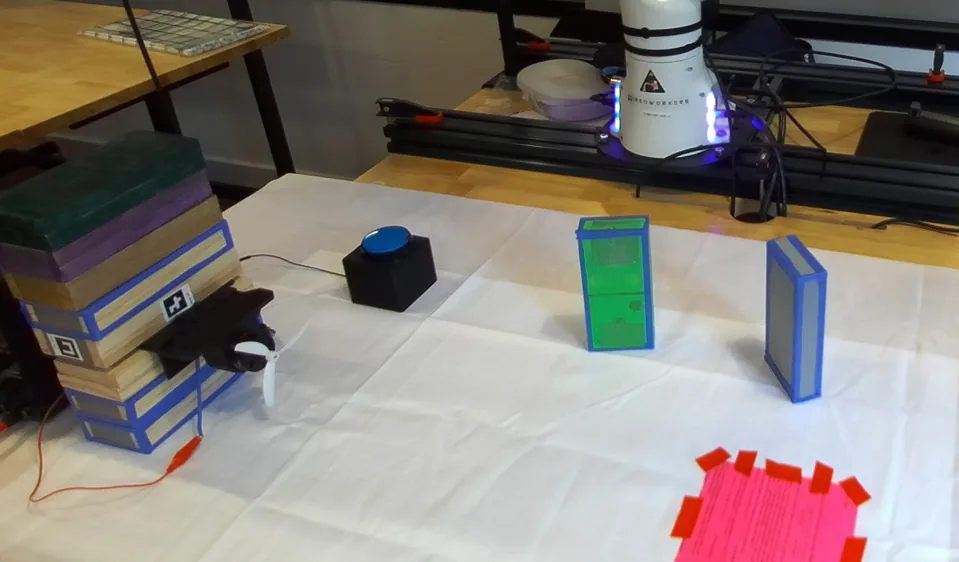
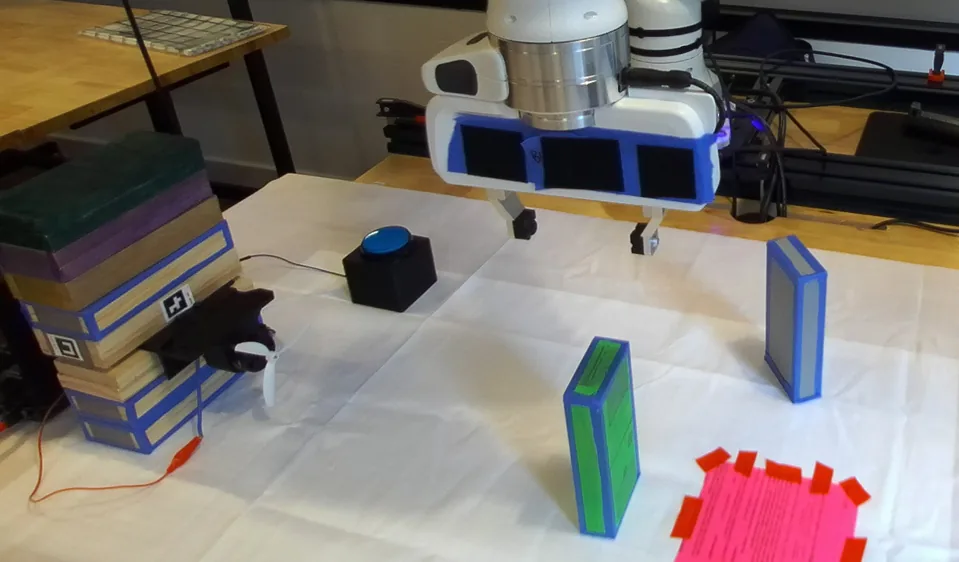
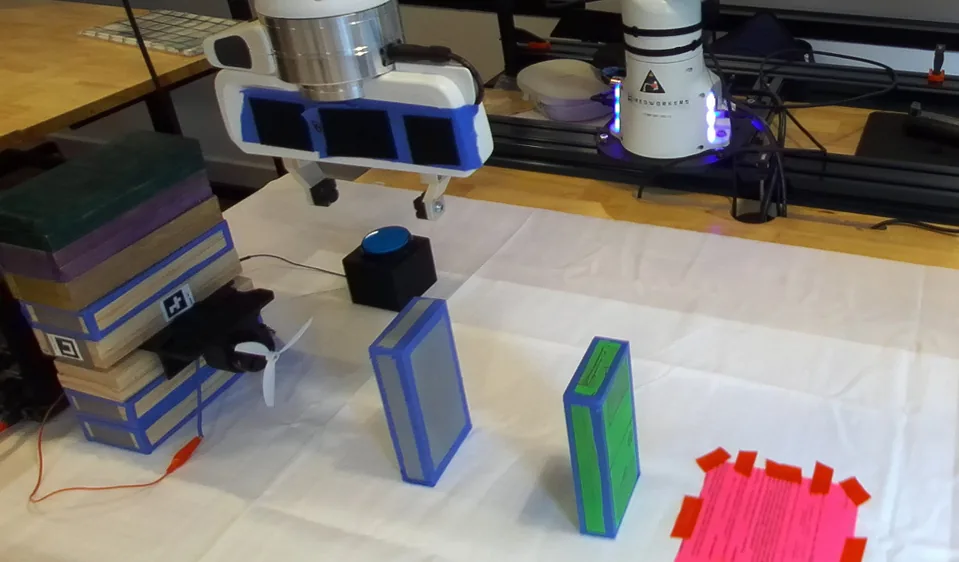
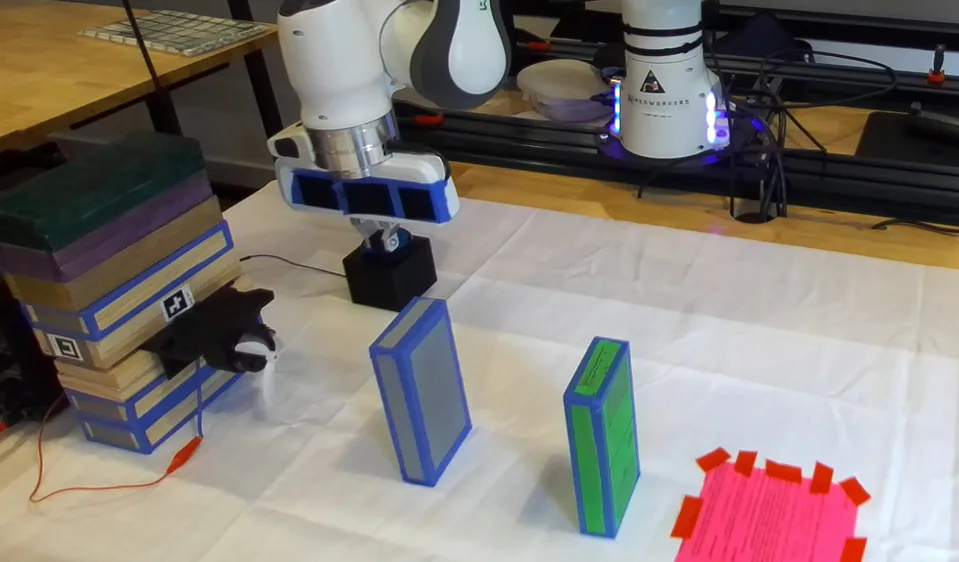
The gray block topples toward the green block and reaches it, the green block falls, and it comes to rest flat in the relocated target.
05 Videos
The paper's figures show one recorded run per domain as frames in time order, from the first experiments to the solved test task. The purple bar marks where the agent writes its simulator program and infers its parameters; dashed frames show what its model predicts for a plan.
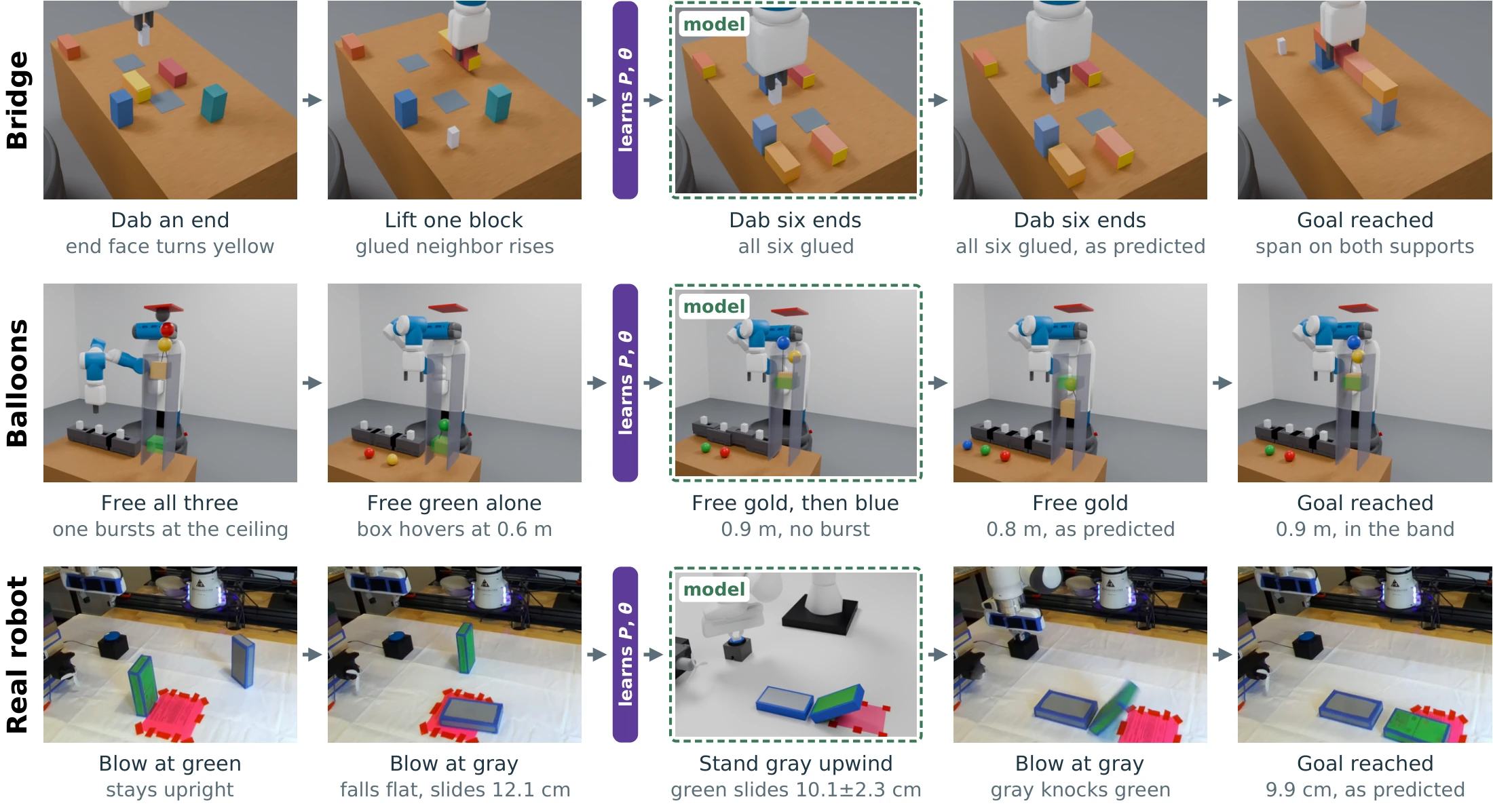
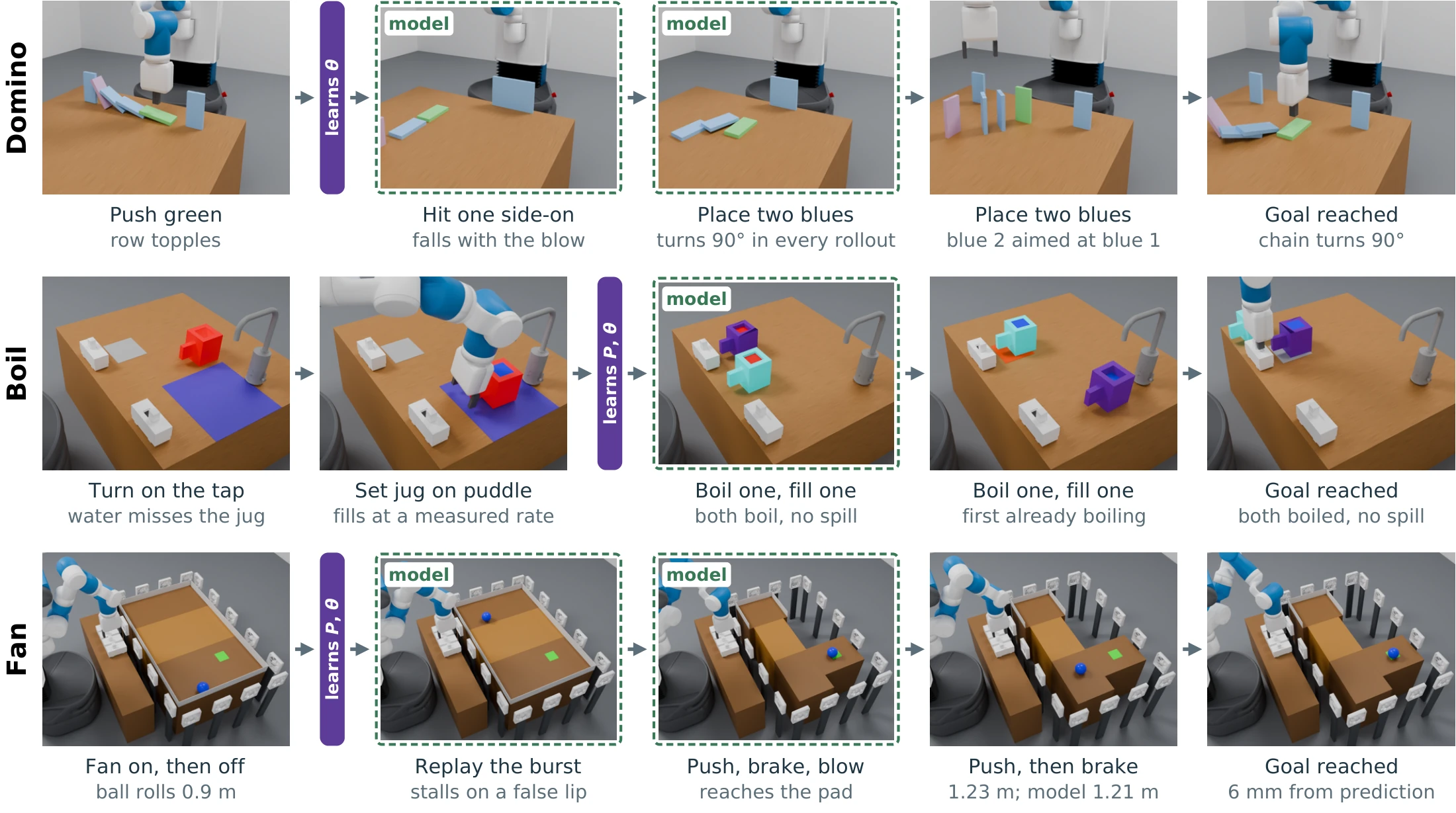
The full recordings below show every step of the same runs: the training tasks, where the agent experiments, then the test task, with the goal, the skill the agent runs and the reason it gave beside the scene.
06 Program
In the Bridge run above, the agent wrote this glue model after a few probes. Its docstring records what the probes showed, its parameters come from the glue readings it recorded, and its cure step turns two glued, touching end faces into a rigid weld in the engine.
1"""Glue-and-weld dynamics for the n-shaped-bridge environment.
2
3Mechanism inferred from real probes on level 1 (see ./journal.md section 2):
4
5* The bottle is a glue dispenser with a downward nozzle at (bx, by, bz - nozzle_drop).
6  Glue is deposited on the upward-facing surface underneath the nozzle only; bringing the
7  bottle alongside a vertical face does nothing (measured at 0.033 m and 0.012 m standoff).
8* Which named face receives the glue depends on where over the block the nozzle sits.
9  Over the middle of the up-facing area -> `glue_top`; over the +x/-x end region ->
10  `glue_end_b` / `glue_end_a`.  For a block standing on end (pitch = -pi/2) the up-facing
11  area IS an end face, so that end is the one that gets glued.
12* Glue is a level that ramps up while the nozzle is held in place (observed 0 -> 0.2 -> 0.4
13  -> 1.0 over the ~4-action dwell that MoveTo performs at its target).
14* Two blocks whose opposing end faces come into contact, with glue on them, fuse into one
15  rigid body and BOTH glue levels are consumed (observed 1.0 -> 0.0 at the weld instant).
16  Observed welds formed on real contact, not merely on being placed 1.3 mm apart.
17
18Glue levels and welds live in model memory (observation-driven); the welds are realised in
19the engine through `restore_model_attachments`, which is what makes a welded assembly move
20and collision-check as one held body.
21"""
⋮
112class BridgeGlueWeld(BaseSimulator):  # noqa: F821  (injected by the loader)
113
114    AGENT_PARAM_SPECS = [
115        # how fast a held nozzle deposits glue (level per action)
116        # directly observed on level 1: the reading stepped 0 -> 0.2 -> 0.4 -> 1.0, so the
117        # per-action deposit is ~0.2; the bounds keep the pose-residual fit from running away
118        # to a degenerate value that the pose data cannot actually see.
119        ParamSpec("glue_rate", 0.2, lo=0.05, hi=0.6),
120        # lateral slop around the up-facing area that still catches the dab
121        ParamSpec("dab_radius", 0.015, lo=0.002, hi=0.05),
122        # how far above the surface the nozzle may sit and still deposit
123        ParamSpec("dab_height", 0.02, lo=0.002, hi=0.06),
124        # fraction of the half-length beyond which a dab counts as an end, not the top
125        ParamSpec("end_frac", 0.55, lo=0.2, hi=0.95),
126        # largest face-to-face gap that still cures into a weld
127        ParamSpec("weld_gap", 0.006, lo=0.001, hi=0.025),
128        # largest lateral (off-axis) offset of two mating end faces that still cures
129        ParamSpec("weld_lateral", 0.02, lo=0.005, hi=0.045),
130        # glue level required before a contact cures
131        ParamSpec("cure_level", 0.15, lo=0.05, hi=0.9),
132        # nozzle offset below the bottle origin
133        ParamSpec("nozzle_drop", 0.03, lo=0.01, hi=0.05),
134    ]
135
136    # Scored quantities: the block poses, which is what the welds actually change.
137    RESIDUAL_FEATURES = {BLOCK_TYPE: ["x", "y", "z", "roll", "pitch", "yaw"]}
138
139    MODEL_STATE_INIT = {"glue": {}, "welds": [], "seen": False}
⋮
210        # 3. cure: opposing end faces in contact with glue on both fuse, consuming the glue.
211        names = sorted(blocks)
212        existing = {tuple(sorted(p)) for p in welds}
213        for i, a in enumerate(names):
214            for b in names[i + 1:]:
215                if tuple(sorted((a, b))) in existing:
216                    continue
217                for fa in ("end_a", "end_b"):
218                    pa, na = _end_point(blocks[a], fa)
219                    for fb in ("end_a", "end_b"):
220                        pb, nb = _end_point(blocks[b], fb)
221                        if float(na @ nb) > -0.9:      # faces must oppose
222                            continue
223                        delta = pb - pa
224                        gap = abs(float(delta @ na))
225                        lateral = float(np.linalg.norm(delta - (delta @ na) * na))
226                        if gap > params["weld_gap"]:
227                            continue
228                        if lateral > params["weld_lateral"]:
229                            continue
230                        if (glue[a][fa] < params["cure_level"]
231                                or glue[b][fb] < params["cure_level"]):
232                            continue
233                        welds.append([a, b])
234                        existing.add(tuple(sorted((a, b))))
235                        glue[a][fa] = 0.0
236                        glue[b][fb] = 0.0
237                        break
238                    else:
239                        continue
240                    break
241 model_state["seen"] = True1"""Glue-and-weld dynamics for the n-shaped-bridge environment.
2
3Mechanism inferred from real probes on level 1 (see ./journal.md section 2):
4
5* The bottle is a glue dispenser with a downward nozzle at (bx, by, bz - nozzle_drop).
6 Glue is deposited on the upward-facing surface underneath the nozzle only; bringing the
7 bottle alongside a vertical face does nothing (measured at 0.033 m and 0.012 m standoff).
8* Which named face receives the glue depends on where over the block the nozzle sits.
9 Over the middle of the up-facing area -> `glue_top`; over the +x/-x end region ->
10 `glue_end_b` / `glue_end_a`. For a block standing on end (pitch = -pi/2) the up-facing
11 area IS an end face, so that end is the one that gets glued.
12* Glue is a level that ramps up while the nozzle is held in place (observed 0 -> 0.2 -> 0.4
13 -> 1.0 over the ~4-action dwell that MoveTo performs at its target).
14* Two blocks whose opposing end faces come into contact, with glue on them, fuse into one
15 rigid body and BOTH glue levels are consumed (observed 1.0 -> 0.0 at the weld instant).
16 Observed welds formed on real contact, not merely on being placed 1.3 mm apart.
17
18Glue levels and welds live in model memory (observation-driven); the welds are realised in
19the engine through `restore_model_attachments`, which is what makes a welded assembly move
20and collision-check as one held body.
21"""
22
23import numpy as np # noqa: F401 (also pre-injected)
24
25from predicators.code_sim_learning.fit_space import ParamSpec
26
27BLOCK_TYPE = "block"
28BOTTLE_TYPE = "bottle"
29FACES = ("top", "end_a", "end_b")
30_HALF = np.array([0.05, 0.025, 0.025])
31
32
33def _rot(roll, pitch, yaw):
34 """World-from-body rotation matrix for the recorded euler triple."""
35 cr, sr = np.cos(roll), np.sin(roll)
36 cp, sp = np.cos(pitch), np.sin(pitch)
37 cy, sy = np.cos(yaw), np.sin(yaw)
38 rx = np.array([[1, 0, 0], [0, cr, -sr], [0, sr, cr]])
39 ry = np.array([[cp, 0, sp], [0, 1, 0], [-sp, 0, cp]])
40 rz = np.array([[cy, -sy, 0], [sy, cy, 0], [0, 0, 1]])
41 return rz @ ry @ rx
42
43
44def _block_frame(feat):
45 """Return (centre, rotation, half-extents) for one observed block."""
46 centre = np.array([feat["x"], feat["y"], feat["z"]])
47 rot = _rot(feat["roll"], feat["pitch"], feat["yaw"])
48 half = np.array([feat.get("half_x", 0.05),
49 feat.get("half_y", 0.025),
50 feat.get("half_z", 0.025)])
51 return centre, rot, half
52
53
54def _up_axis(rot):
55 """Which local axis points most nearly straight up, and its sign."""
56 col_z = rot[2, :] # world-z component of each local axis
57 axis = int(np.argmax(np.abs(col_z)))
58 return axis, float(np.sign(col_z[axis]) or 1.0)
59
60
61def _dab_face(feat, nozzle, params):
62 """Face name the nozzle would glue, or None.
63
64 The nozzle must sit above the block's up-facing surface, within `dab_height` of it and
65 inside its lateral extent (plus `dab_radius` of slop). The face is the top face unless
66 the hit point lies in the outer `1 - end_frac` fraction of the long (local x) axis, in
67 which case it is the corresponding end face. When the up-facing surface is itself an
68 end face (a block standing on end), that end face is the one glued.
69 """
70 centre, rot, half = _block_frame(feat)
71 axis, sign = _up_axis(rot)
72 local = rot.T @ (nozzle - centre)
73 height = sign * local[axis] - half[axis]
74 if height < -1e-4 or height > params["dab_height"]:
75 return None
76 # lateral containment in the other two axes
77 for other in range(3):
78 if other == axis:
79 continue
80 if abs(local[other]) > half[other] + params["dab_radius"]:
81 return None
82 if axis == 0:
83 return "end_b" if sign > 0 else "end_a"
84 # up-facing area is a long face: pick top vs end from the position along local x
85 if local[0] > params["end_frac"] * half[0]:
86 return "end_b"
87 if local[0] < -params["end_frac"] * half[0]:
88 return "end_a"
89 return "top"
90
91
92def _end_point(feat, face):
93 """World position of the centre of an end face, and its outward normal."""
94 centre, rot, half = _block_frame(feat)
95 sign = 1.0 if face == "end_b" else -1.0
96 normal = sign * rot[:, 0]
97 return centre + normal * half[0], normal
98
99
100def _observed(observation, type_name):
101 out = {}
102 for obj in observation:
103 if obj.type.name != type_name:
104 continue
105 out[obj.name] = {
106 f: float(observation.get(obj, f))
107 for f in obj.type.feature_names
108 }
109 return out
110
111
112class BridgeGlueWeld(BaseSimulator): # noqa: F821 (injected by the loader)
113
114 AGENT_PARAM_SPECS = [
115 # how fast a held nozzle deposits glue (level per action)
116 # directly observed on level 1: the reading stepped 0 -> 0.2 -> 0.4 -> 1.0, so the
117 # per-action deposit is ~0.2; the bounds keep the pose-residual fit from running away
118 # to a degenerate value that the pose data cannot actually see.
119 ParamSpec("glue_rate", 0.2, lo=0.05, hi=0.6),
120 # lateral slop around the up-facing area that still catches the dab
121 ParamSpec("dab_radius", 0.015, lo=0.002, hi=0.05),
122 # how far above the surface the nozzle may sit and still deposit
123 ParamSpec("dab_height", 0.02, lo=0.002, hi=0.06),
124 # fraction of the half-length beyond which a dab counts as an end, not the top
125 ParamSpec("end_frac", 0.55, lo=0.2, hi=0.95),
126 # largest face-to-face gap that still cures into a weld
127 ParamSpec("weld_gap", 0.006, lo=0.001, hi=0.025),
128 # largest lateral (off-axis) offset of two mating end faces that still cures
129 ParamSpec("weld_lateral", 0.02, lo=0.005, hi=0.045),
130 # glue level required before a contact cures
131 ParamSpec("cure_level", 0.15, lo=0.05, hi=0.9),
132 # nozzle offset below the bottle origin
133 ParamSpec("nozzle_drop", 0.03, lo=0.01, hi=0.05),
134 ]
135
136 # Scored quantities: the block poses, which is what the welds actually change.
137 RESIDUAL_FEATURES = {BLOCK_TYPE: ["x", "y", "z", "roll", "pitch", "yaw"]}
138
139 MODEL_STATE_INIT = {"glue": {}, "welds": [], "seen": False}
140
141 # ---------------------------------------------------------------- memory
142
143 # Generous slack used only to decide whether a REMEMBERED weld is still plausible.
144 # It must be looser than the curing tolerances so observation noise on a genuinely
145 # welded pair can never prune it.
146 STALE_GAP = 0.035
147 STALE_LATERAL = 0.045
148
149 @classmethod
150 def _pair_adjacency(cls, fa, fb):
151 """Return (face_a, face_b) if the two blocks sit end-to-end, else None."""
152 best = None
153 for face_a in ("end_a", "end_b"):
154 pa, na = _end_point(fa, face_a)
155 for face_b in ("end_a", "end_b"):
156 pb, nb = _end_point(fb, face_b)
157 if float(na @ nb) > -0.85:
158 continue
159 delta = pb - pa
160 gap = abs(float(delta @ na))
161 lateral = float(np.linalg.norm(delta - (delta @ na) * na))
162 if gap <= cls.STALE_GAP and lateral <= cls.STALE_LATERAL:
163 if best is None or gap < best[2]:
164 best = (face_a, face_b, gap)
165 return None if best is None else (best[0], best[1])
166
167 @classmethod
168 def update_model_state(cls, observation, model_state, params, action):
169 blocks = _observed(observation, BLOCK_TYPE)
170 bottles = _observed(observation, BOTTLE_TYPE)
171 glue = model_state.setdefault("glue", {})
172 welds = model_state.setdefault("welds", [])
173 for name in blocks:
174 glue.setdefault(name, {f: 0.0 for f in FACES})
175
176 # 0. consistency: a weld is rigid, so its two blocks must still be end-adjacent in
177 # the current observation. Any remembered pair that is not is stale (e.g. memory
178 # carried across episodes, or a joint that never really took) and is dropped.
179 kept = []
180 for pair in welds:
181 a, b = pair[0], pair[1]
182 if a not in blocks or b not in blocks:
183 continue
184 if cls._pair_adjacency(blocks[a], blocks[b]) is not None:
185 kept.append(pair)
186 welds[:] = kept
187
188 # 1. trust the environment's own glue readings when they are present: they are
189 # observable features, so tracking a real episode needs no integration at all.
190 for name, feat in blocks.items():
191 for face in FACES:
192 key = "glue_" + face
193 if key in feat:
194 glue[name][face] = max(glue[name][face], float(feat[key]))
195
196 # 2. dispense from a held bottle onto the surface under the nozzle.
197 for feat in bottles.values():
198 if feat.get("is_held", 0.0) < 0.5:
199 continue
200 nozzle = np.array([feat["x"], feat["y"],
201 feat["z"] - params["nozzle_drop"]])
202 for name, bfeat in blocks.items():
203 if bfeat.get("is_held", 0.0) > 0.5:
204 continue
205 face = _dab_face(bfeat, nozzle, params)
206 if face is not None:
207 glue[name][face] = min(1.0, glue[name][face]
208 + params["glue_rate"])
209
210 # 3. cure: opposing end faces in contact with glue on both fuse, consuming the glue.
211 names = sorted(blocks)
212 existing = {tuple(sorted(p)) for p in welds}
213 for i, a in enumerate(names):
214 for b in names[i + 1:]:
215 if tuple(sorted((a, b))) in existing:
216 continue
217 for fa in ("end_a", "end_b"):
218 pa, na = _end_point(blocks[a], fa)
219 for fb in ("end_a", "end_b"):
220 pb, nb = _end_point(blocks[b], fb)
221 if float(na @ nb) > -0.9: # faces must oppose
222 continue
223 delta = pb - pa
224 gap = abs(float(delta @ na))
225 lateral = float(np.linalg.norm(delta - (delta @ na) * na))
226 if gap > params["weld_gap"]:
227 continue
228 if lateral > params["weld_lateral"]:
229 continue
230 if (glue[a][fa] < params["cure_level"]
231 or glue[b][fb] < params["cure_level"]):
232 continue
233 welds.append([a, b])
234 existing.add(tuple(sorted((a, b))))
235 glue[a][fa] = 0.0
236 glue[b][fb] = 0.0
237 break
238 else:
239 continue
240 break
241 model_state["seen"] = True
242
243 # ------------------------------------------------------------- dynamics
244
245 def _weld_pairs(self):
246 """Remembered welds, gated on the pair still being end-adjacent right now.
247
248 The gate matters because remembered welds can be stale (memory reconstructed over a
249 different episode). A weld is rigid, so a remembered pair that is nowhere near
250 end-to-end in the live scene cannot be real and must not be realised in the engine.
251 """
252 state = self.model_state or {}
253 pairs = [(p[0], p[1]) for p in state.get("welds", [])]
254 if not pairs:
255 return []
256 try:
257 blocks = _observed(self.get_observation(), BLOCK_TYPE)
258 except Exception: # pragma: no cover - keep raw memory if unreadable
259 return pairs
260 out = []
261 for a, b in pairs:
262 if a in blocks and b in blocks:
263 if self._pair_adjacency(blocks[a], blocks[b]) is not None:
264 out.append((a, b))
265 return out
266
267 def _publish_links(self, force=False):
268 """Register the inferred rigid links, but ONLY when the set changes.
269
270 Re-registering an unchanged link every step re-creates the engine constraint at the
271 latest relative transform, which pumps energy into the assembly (observed: a welded
272 beam jittering off the table). Publishing on change only keeps the joint rigid and
273 the rollout stable. The empty set is published too, so a pruned weld disappears.
274 """
275 pairs = self._weld_pairs()
276 key = tuple(sorted(tuple(sorted(p)) for p in pairs))
277 if force or key != getattr(self, "_published_links", None):
278 self.restore_model_attachments(pairs)
279 self._published_links = key
280
281 def _domain_specific_step(self):
282 self._publish_links()
283
284 def restore_model_state(self):
285 self._published_links = None
286 self._publish_links(force=True)
287
288
289RESIDUAL_ENV = BridgeGlueWeld
290RESIDUAL_FEATURES = BridgeGlueWeld.RESIDUAL_FEATURES07 Citation
@article{liang2026empiric,
  title   = {{EMPIRIC}: Experiment-Driven Learning of Residual World Models for Robot Planning},
  author  = {Liang, Yichao and Li, Amber and Nguyen, Dat and Bunnapradist, Emily and Naim, Michelangelo and Kodali, Sreela and Merler, Matteo and Li, Bowen and Gopinathan, Kiran and Liu, Yiyun and Pimpalkhare, Nikhil and Tenenbaum, Joshua B. and Weller, Adrian and Tavares, Zenna and Silver, Tom and Ellis, Kevin},
  journal = {arXiv preprint arXiv:2609.35047},
  year    = {2026}
}