Dynestyx in a Nutshell
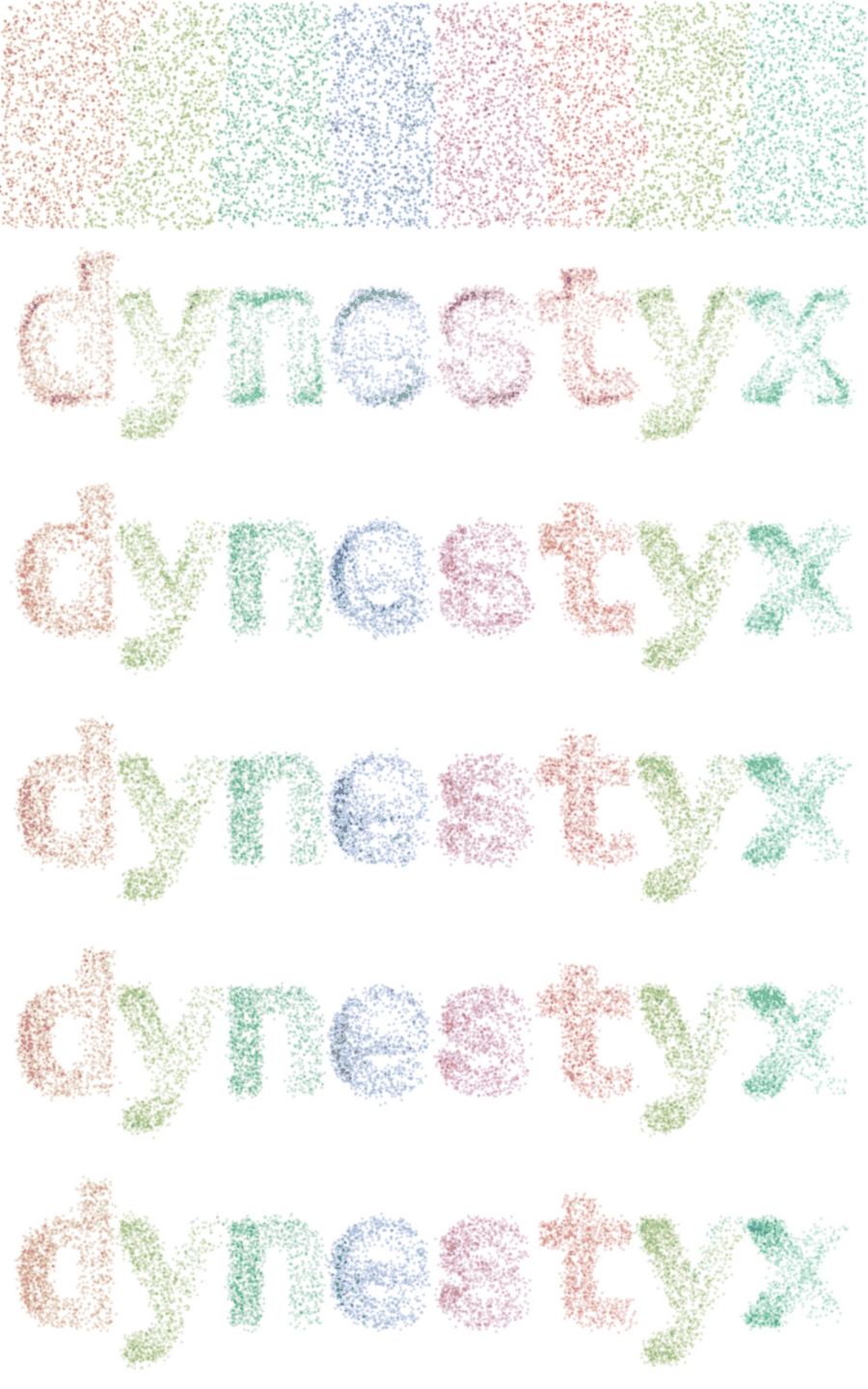
dynestyx is a library for Bayesian modeling and inference of dynamical systems. It extends NumPyro to provide state-of-the-art inference methods for state space models—with a clear separation between what the model is and how you simulate or infer it.
Why dynestyx? It seamlessly wraps our favorite ways to learn dynamics from messy time-series data (and there are many!) in a principled NumPyro Bayesian workflow. The engines under-the-hood address noise, partial observations, irregular samples, uncertainties, hierarchical/mixed-effect/multiple-trajectory SSMs, and just about any model class you want to try out! Don't see your favorite methods? Tell us about it---or better, contribute by submitting a Pull Request!
Features
- Unified API — Discrete-time and continuous-time dynamical systems (SDEs, ODEs, HMMs) in one interface
- Rich model class - Define custom initial conditions, state evolution processes, and observation models
- Decoupled model and inference — Write your model once; choose simulators, filters, or MCMC/Variational inference independently
- Multiple inference methods — joint state-and-parameter inference (via NUTS or stochastic variational inference), filters for marginalization (KF, EnKF, EKF, UKF, Particle Filter), pseudo-marginal MCMC (particle filter or EnKF within NUTS), gradient-matching.
- NumPyro integration — Builds on NumPyro’s probabilistic programming primitives, handlers, and inference stack
- JAX-based — Fully JIT-compilable and GPU-compatible
Installation
We recommend uv:
uv pip install dynestyx
Or with pip:
pip install dynestyx
Documentation versions
Published docs use versioned builds: stable matches the latest git tag (e.g. v0.0.1); latest matches the main branch. Use the version menu in the site header to switch. See Versioned documentation for install commands and how this relates to notebooks.
Quick Example: Simulation
Define a dynamical model, wrap it with a simulator, and generate synthetic trajectories by passing observation times (and optionally controls) as kwargs:
import jax.numpy as jnp
import jax.random as jr
import numpyro
import numpyro.distributions as dist
import dynestyx as dsx
from dynestyx import DynamicalModel, DiscreteTimeSimulator
from numpyro.infer import Predictive

def model(phi=None, obs_times=None, obs_values=None):
    phi = numpyro.sample("phi", dist.Uniform(0.0, 1.0), obs=phi)
    dynamics = DynamicalModel(
        control_dim=0,
        initial_condition=dist.Normal(0.0, 1.0),
        state_evolution=lambda x, u, t_n, t_next: dist.Normal(phi * x, 0.5),
        observation_model=lambda x, u, t: dist.Normal(0.0, jnp.exp(x / 2.0)),
    )
    return dsx.sample("f", dynamics, obs_times=obs_times, obs_values=obs_values)

obs_times = jnp.arange(0.0, 100.0, 1.0)
with DiscreteTimeSimulator():
    samples = Predictive(model, num_samples=1)(jr.PRNGKey(0), phi=0.9, predict_times=obs_times)
Quick Example: Inference
Using the simulated samples and obs_times from above, condition on the data and infer parameters with a filter plus NUTS (no explicit state sampling):
from dynestyx import Filter
from dynestyx.inference.filters import ContinuousTimeEnKFConfig
from numpyro.infer import MCMC, NUTS

obs_values = samples["f_observations"][0]

def inference_model():
    with Filter(filter_config=ContinuousTimeEnKFConfig(n_particles=25)):
        return model(obs_times=obs_times, obs_values=obs_values)

mcmc = MCMC(NUTS(inference_model), num_warmup=100, num_samples=100)
mcmc.run(jr.PRNGKey(1))
posterior = mcmc.get_samples()
See the Lorenz 63 notebook for a full SDE example with partial noisy observations.
Citation
If you use dynestyx in your research, please cite:
@software{dynestyx,
  author = {{Basis Research Institute}},
  title = {dynestyx: Bayesian inference for dynamical systems},
  year = {2025},
  url = {https://github.com/BasisResearch/dynestyx},
}
Next Steps
- A mathematical introduction — Clearly defines the mathematical and statistical problems that
dynestyxallows you to address. It maps concepts/algorithms to relevant pieces of code. - Tutorials — Multi-part tutorial from NumPyro and Bayesian workflow → discrete-time dynestyx → filtering and MLL → pseudomarginal inference → SVI → continuous-time (SDEs) → HMMs
- Examples — Quickstart, discrete-time inference, SDE inference, HMM inference, ODE inference, and more
See also
Other JAX-based libraries for dynamical systems:
- dynamax — Discrete-time state space models with linear/non-linear Kalman filters and Bayesian parameter estimation
- cd-dynamax — Continuous-discrete state space models with EnKF, EKF, UKF, PF and Bayesian parameter estimation
- PFJax — Nonlinear and non-Gaussian discrete-time models with particle filters and particle MCMC
- Cuthbert — Discrete-time state space models with linear/non-linear Kalman, ensemble Kalman, and particle filters, plus options for associative scans.
- diffrax - Numerical differential equation solvers.
Other probabilistic programming languages with support for dynamical systems:
- Stan — Probabilistic programming with Hamiltonian Monte Carlo
- ODEs in Stan — ODEs are a special transformation requiring little extra treatment from the user
- NumPyro — JAX-based probabilistic programming
- ODEs in NumPyro — ODE solver must be defined inside the model (violates separation of concerns)
- SDEs in NumPyro —
dist.EulerMaruyamainfers every Gaussian increment from an Euler–Maruyama solver
- ChiRho — Probabilistic programming with causal tooling
- ODEs in ChiRho — Hierarchical parameter inference in ODEs
- PyMC - Probabilistic programming in Python
- SSMs in PyMC - doc page in
pymc_extras. - Hurricane forecasting example in PyMC - Requires manual discretization of continuous-time systems, and limited support for non-linear systems. They write "Hopefully, someday the
StateSpacemodule inpymc-extrasmay support non-linear state space specifications with either the Extended Kalman Filter or with the Unscented Kalman Filter."
- SSMs in PyMC - doc page in